Hormuz Deadline to Iran: Stunning, Best-Case Move


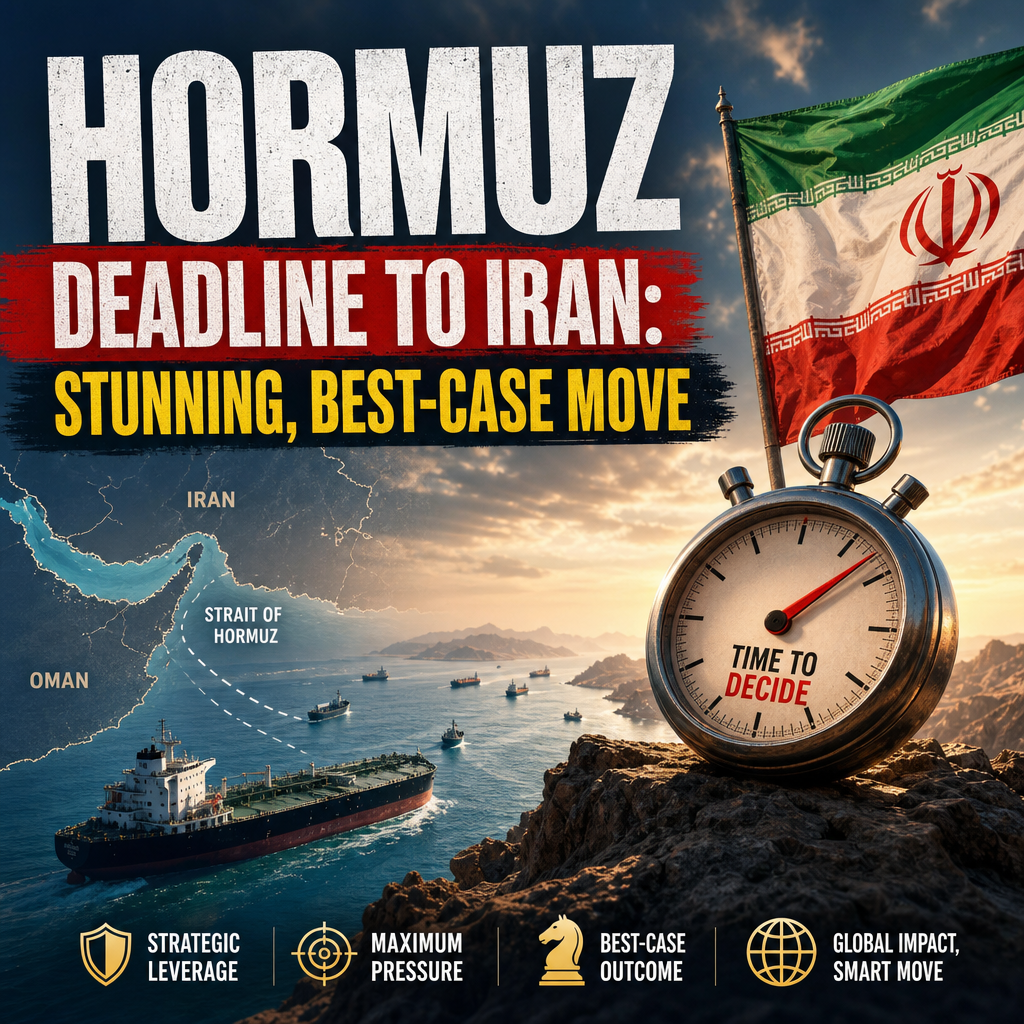
Hormuz deadline to Iran highlights how fragile the Gulf’s security picture remains, and why even a temporary shift in tone can matter as much as any military move.
The Strait of Hormuz is one of the world’s most sensitive shipping lanes, carrying a significant share of global oil and LNG traffic. So when talk turns to deadlines, warnings, or potential reopening arrangements, the stakes extend far beyond Iran’s borders. Energy markets, Gulf neighbors, and major powers all have an interest in avoiding a confrontation that could rattle trade, raise prices, and invite a wider crisis.



What makes the latest discussion striking is not just the threat itself, but the possibility that diplomacy may still be doing quiet work behind the scenes. Some reporting and analysis frame the situation as a test of deterrence: can pressure and deadlines force restraint without triggering a direct clash? Others see it as another reminder that the Strait is less a battlefield than a bargaining chip, used by Tehran to signal resolve while seeking strategic leverage.
Why the Hormuz deadline to Iran matters far beyond Iran
The Strait of Hormuz has long been a pressure point in Middle East politics because of its geography. It is narrow, heavily trafficked, and indispensable to energy exporters and importers alike. Any suggestion of disruption immediately prompts concern in shipping markets and among governments that rely on stable transit.




That is why the current debate has drawn such wide attention. In broad terms, there are three competing readings of what a deadline or reopening demand could mean:
– A de-escalation signal: Iran may be looking for a face-saving exit that allows tensions to cool without appearing to retreat.
– A coercive message: The deadline could be intended to show that Iran still has tools to disrupt global trade if pushed too far.
– A negotiation tactic: It may simply be a way to extract concessions, attention, or guarantees from rivals and intermediaries.
Al Jazeera’s broader regional coverage often emphasizes the political context behind such moves: the interplay of sanctions, proxy conflicts, and the enduring mistrust between Iran and Western powers. That lens matters because the Strait is rarely just about ships. It is usually about the broader strategic balance, from nuclear negotiations to regional deterrence.
Sky News reporting on Gulf security tends to focus more directly on the market and security implications: even the hint of disruption can drive insurance costs higher and add uncertainty to an already volatile region. That perspective is useful because it highlights how fragile confidence can be, especially for commercial shipping that depends on predictability more than rhetoric.
RT’s coverage frequently stresses the theme of pressure and sovereignty, often presenting Iran’s decisions as responses to external threats rather than isolated provocations. Whether one agrees with that framing or not, it captures an important part of the story: Tehran routinely argues that it is reacting to sanctions, military encirclement, or hostile messaging, not simply escalating for its own sake.
Best-case move, or just another pause before the next crisis?
Calling any opening around Hormuz a “best-case move” is tempting, because de-escalation is plainly preferable to confrontation. If the deadline leads to reduced tension, safer shipping lanes, and a reopening path for dialogue, that would be a welcome result. But the optimism should be limited. In this region, temporary relief often does not mean a durable settlement.
What a genuinely positive outcome would require
A real breakthrough would likely need more than a verbal commitment or a short-term pause. It would probably require:
– clearer communication channels between Iran and regional powers
– guarantees that shipping will not be targeted or harassed
– some form of monitored deconfliction mechanism
– a broader diplomatic framework addressing sanctions, security, and nuclear concerns
Without those elements, a deadline can look less like progress and more like a holding pattern.
There is also a hard reality that both critics and supporters of Iran’s approach acknowledge: closing or threatening Hormuz is not cost-free for Tehran. Even when such threats succeed in attracting attention, they also risk alienating neighbors, inviting stronger naval coordination among rivals, and undermining the very economic stability Iran says it needs. In that sense, the move can be seen as powerful but limited—a sharp instrument that may win leverage, yet deepen mistrust.
The bigger problem: leverage without trust
The central challenge is that every side sees the Strait through a different lens. Iran views pressure as something to be answered with pressure. Gulf states view any threat to shipping as an existential concern. Western governments tend to read it as a test of international resolve. Meanwhile, commercial actors mostly want one thing: no surprises.
That is why the current moment feels so important, even if the details remain fluid. If the deadline leads to restraint, it may show that the parties understand how close the region can come to a dangerous spiral. If it fails, the result could be another cycle of warnings, counterwarnings, and market anxiety.
The most responsible conclusion is also the least dramatic: there is still room for a limited diplomatic win, but no reason to assume one has arrived. The best-case move would be a quiet step back from brinkmanship, paired with practical safeguards for shipping and communication. Anything less may simply postpone the next crisis at the same narrow waterway.
For now, Hormuz remains what it has always been: a strategic chokepoint where military power, economic pressure, and political theater collide. And when deadlines are involved, the world has learned to treat calm not as a conclusion, but as a temporary achievement that still has to be protected.